
Router Bits
10 Router Bits Every Woodworker Should Own (And When to Use Each One)
10 Router Bits Every Woodworker Should Own (And When to Use Each One)
Meta Title: 10 Router Bits Every Woodworker Should Own (2026 List)
Meta Description: The 10 router bits every woodworker needs — from straight bits to dovetails. Learn what each one does and when to reach for it.
URL Slug: /blog/essential-router-bits-every-woodworker
Target Keyword: router bits every woodworker should own
Search Volume: 9,900/mo
Word Count: 2,000–2,500
Schema: HowTo + Article
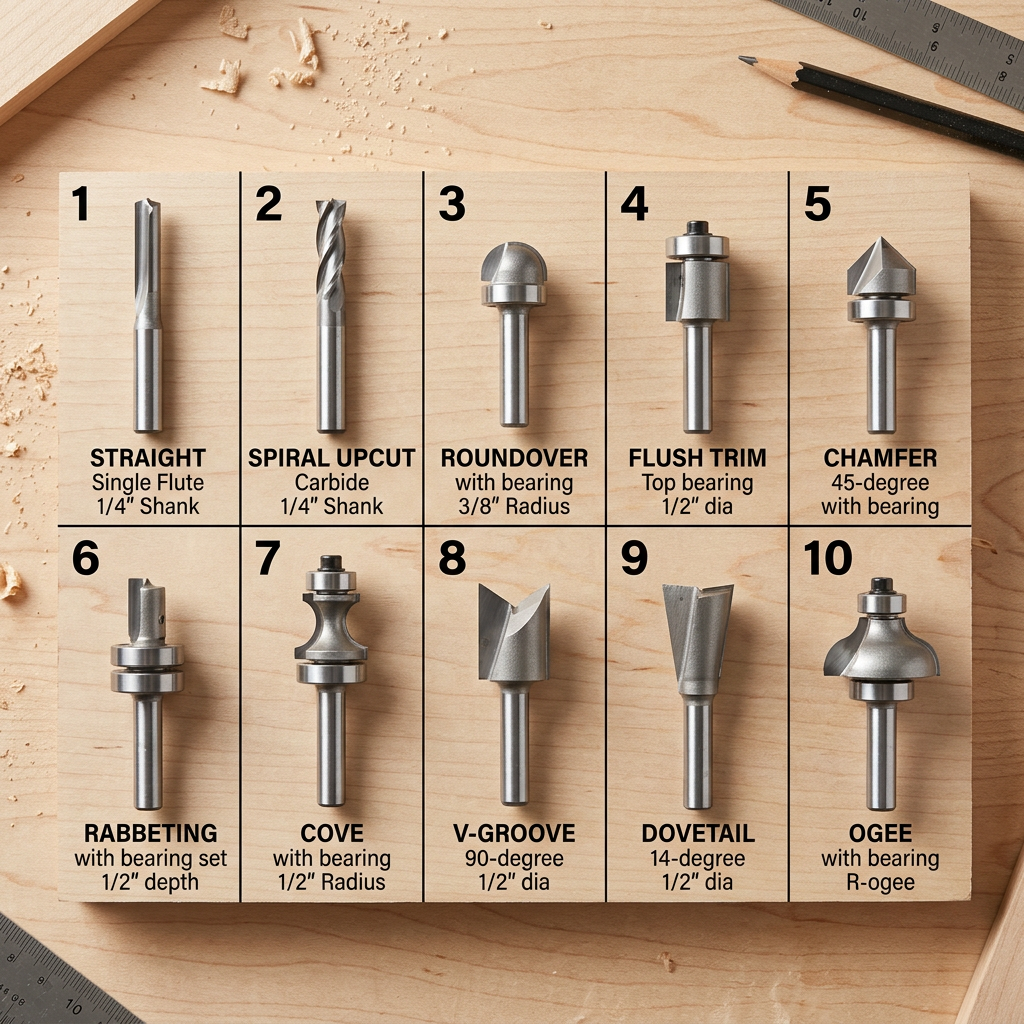
AI Summary: These 10 router bits cover 95% of all routing operations: straight bit, spiral upcut, flush trim, roundover (1/4"), roundover (3/8"), chamfer, rabbeting, dovetail, cove, and slot-cutting. Each entry explains what the bit does, when to use it, what material to buy, and which brand offers the best quality for the price. All bits available through Burnette Tools, an authorized CMT distributor.
Why 10 Bits Is All You Need
Skip the 50-piece sets. They're full of profiles you'll never use, made from carbide that dulls in a week.
These 10 bits handle every operation from rough dimensioning to fine furniture finishing. Buy quality versions of each — CMT, Freud, or Amana — and they'll last years with proper maintenance.
For help choosing between brands, see our CMT vs Freud vs Amana comparison.
Bit #1: Straight Bit (1/2" Diameter, 1/2" Shank)
What It Does
Cuts flat-bottomed grooves, dados, rabbets, and mortises. This is the most versatile router bit in existence.
When to Use It
- Cutting dado joints for shelving
- Grooves for drawer bottoms
- Rabbets for cabinet backs (with fence)
- Mortises for loose tenon joinery
- Template routing (with guide bushing)
What to Buy
- 1/2" shank, 1/2" cutting diameter
- 2-flute, carbide-tipped
- CMT: 811.002.11 — excellent value, clean cuts
- Freud: 34-104 — precision ground, great for hardwoods
Pro Tip
For grooves deeper than 1/4", make multiple passes at 1/4" depth increments. One deep pass causes burning and stress on the bit.
Bit #2: Spiral Upcut Bit (1/4" Diameter, 1/2" Shank)
What It Does
Cuts with a helical flute that pulls chips upward and out of the cut. Produces cleaner cuts than straight bits, especially in end grain.
When to Use It
- Mortising (clean bottom edge)
- Plunge cuts (bit enters material vertically)
- Deep grooves in hardwood
- Cutting mortises for floating tenons
- Any cut where chip evacuation is critical
What to Buy
- 1/4" diameter, 1/2" shank
- Solid carbide for best results
- CMT: 800.502.11 — solid carbide, clean cuts
- Amana: 46102-K — Spektra coated, long-lasting
Pro Tip
Upcut bits pull fibers upward, which can cause tear-out on the top surface of veneered plywood. If you need a clean top edge, switch to a downcut or compression spiral. Our straight vs spiral guide explains when to use each.
Bit #3: Flush Trim Bit (1/2" Diameter, 1/2" Shank, Top Bearing)
What It Does
Trims one material flush with another using a bearing guide. The bearing follows the template or adjacent surface while the carbide cuts the overhanging material.
When to Use It
- Pattern routing (duplicating shapes from a template)
- Flushing edge banding and veneer
- Trimming tabletops after glue-up
- Formica and laminate trimming
- Duplicating parts with a pattern
What to Buy
- 1/2" diameter, 1/2" shank, top-mounted bearing
- Carbide-tipped, 2-flute
- CMT: 822.001.11 — reliable bearing, sharp carbide
- Freud: 34-120 — excellent bearing quality
Pro Tip
When pattern routing, always leave 1/16" of material proud of the template. Don't try to flush trim a full 1/4" overhang in one pass — the bit will chatter and burn.
Bit #4: Roundover Bit (1/4" Radius, 1/2" Shank)
What It Does
Creates a smooth, quarter-round profile on edges. The most commonly used decorative profile in woodworking.
When to Use It
- Softening sharp edges on cutting boards
- Tabletops and shelf edges
- Cabinet door edges
- Stair treads (safety)
- Anywhere you want a comfortable, rounded edge
What to Buy
- 1/4" radius, 1/2" shank
- Carbide-tipped with bearing pilot
- CMT: 838.064.11 — clean profile, durable bearing
- Freud: 34-110 — excellent for hardwoods
Pro Tip
Most roundover bits come with a removable bearing. Remove the bearing and the bit cuts a full quarter-round rabbet. This gives you two operations from one bit.
Bit #5: Roundover Bit (3/8" Radius, 1/2" Shank)
What It Does
Same as the 1/4" roundover but with a larger, more pronounced curve.
When to Use It
- Larger furniture pieces (proportional edge profile)
- Outdoor furniture (more comfortable grip)
- Heavier tabletops
- Combined with other profiles for complex molding
What to Buy
- 3/8" radius, 1/2" shank
- Carbide-tipped with bearing pilot
- Same brands as 1/4" — just the larger size
Pro Tip
If you're only buying one roundover, make it the 1/4". You can always do multiple passes to build up a larger profile, but you can't make a 3/8" roundover smaller. The 3/8" is your second purchase when your projects demand it.
Bit #6: Chamfer Bit (45°, 1/2" Shank)
What It Does
Cuts a clean, 45° beveled edge. Creates a modern, geometric profile that's the alternative to the softness of a roundover.
When to Use It
- Picture frames
- Contemporary furniture edges
- Box joints and miter joints (pre-cuts the 45°)
- Edge breaking (safety alternative to roundover)
- Wainscoting and panel details
What to Buy
- 45° angle, 1/2" shank
- Carbide-tipped with bearing
- CMT: 843.064.11 — precise angle, clean cuts
- Freud: 34-130 — sharp out of the box
Pro Tip
Chamfer bits with adjustable bearings let you control how far up the edge the chamfer reaches. With the bearing removed, the chamfer cuts deeper — useful for creating compound profiles with other bits.
Bit #7: Rabbeting Bit Set (1/2" Shank, with Interchangeable Bearings)
What It Does
Cuts an L-shaped recess (rabbet) along the edge of a board. Comes with multiple bearings to adjust rabbet width from 3/16" to 1/2".
When to Use It
- Cabinet back panels (inset)
- Drawer box construction
- Shelving with inset panels
- Frame-and-panel doors
- Anywhere you need a step-cut along an edge
What to Buy
- 1/2" shank, carbide-tipped
- MUST come with interchangeable bearings (this is the key feature)
- CMT: 823.001.11 — full bearing set included
- Freud: 34-140 — reliable bearing changes
Pro Tip
Label your bearings. When you swap bearings mid-project, you don't want to guess which bearing cuts which width. A piece of tape with the width written on it saves time and prevents mistakes.
Bit #8: Dovetail Bit (1/2" Shank, 14° Angle)
What It Does
Cuts the angled pins and tails for dovetail joints — the strongest and most beautiful joint in woodworking.
When to Use It
- Dovetail joints (with dovetail jig)
- Box joints (with different jig setup)
- Decorative inlay grooves
- Fluted columns (with router table)
What to Buy
- 14° angle, 1/2" shank (most common for jigs)
- Carbide-tipped
- CMT: 815.501.11 — precise angle, sharp carbide
- Amana: 45734 — premium quality, extra resharpenings
Pro Tip
The angle of the dovetail bit determines the look of the joint. 14° gives you a traditional, widely-spaced dovetail. 7° creates tighter, more delicate-looking joints. Match the bit angle to your jig's specifications.
Bit #9: Cove Bit (1/4" Radius, 1/2" Shank)
What It Does
Creates a concave (inward) curve — the opposite of a roundover. Produces elegant, traditional molding profiles.
When to Use It
- Decorative edges on furniture
- Combined with roundover for complex molding
- Fluted details on columns
- Panel edge profiles
- Traditional molding reproduction
What to Buy
- 1/4" radius, 1/2" shank
- Carbide-tipped with bearing
- CMT: 839.064.11 — smooth profile
- Freud: 34-150 — clean cutting
Pro Tip
Combine a cove bit on one edge and a roundover on the adjacent edge to create a full ogee profile — without buying an ogee bit. This is the traditional technique for custom molding.
Bit #10: Slot-Cutting Bit (1/8" Width, 1/2" Shank)
What It Does
Cuts a thin, precise slot along the edge or face of a board. Small diameter (typically 1" to 2") keeps the cut controlled.
When to Use It
- Spline joints (strengthening miter joints)
- T-molding slots (for edge banding)
- Panel grooves (for frame-and-panel construction)
- Coin slots, keyhole slots, and cable routing
What to Buy
- 1/8" slot width, 1/2" shank (most versatile width)
- Carbide-tipped with bearing
- CMT: 824.064.11 — precise slot width
- Freud: 34-160 — clean cuts in hardwood
Pro Tip
For spline joints in mitered corners, cut slots in both mating surfaces before assembly. Glue a thin plywood spline into the slots. This creates a joint that's stronger than a standard miter and easier to align during clamping.
Where to Buy Quality Router Bits
Don't buy router bits from the bargain bin. Cheap carbade dulls fast, costs more per cut, and produces cuts you'll spend hours sanding.
Buy from authorized distributors who guarantee genuine products with full manufacturer warranty. Burnette Tools is an authorized CMT distributor carrying CMT, Freud, Amana, and FS Tools — all with verified quality and full warranty support.
They also offer professional router bit sharpening to extend the life of your investment.
Frequently Asked Questions
Q: Can I get by with fewer than 10 bits?
A: Yes. If you're just starting, buy bits #1 (straight), #3 (flush trim), and #4 (roundover 1/4"). These three cover 80% of beginner projects.
Q: Should I buy all 10 at once?
A: No. Buy the three essentials first. Then add bits as your projects demand them. You'll appreciate the quality more when you're not staring at 10 unused bits in a case.
Q: What's the difference between a router bit set and buying individually?
A: Sets use lower-quality carbide to hit a price point. Individual bits from CMT, Freud, or Amana use premium carbide that stays sharp 5–10x longer. The individual bits cost more upfront but save money over time.
Q: Do I need a router table for these bits?
A: Not all of them. Roundover, chamfer, and flush trim bits work great handheld. Straight, rabbeting, and slot-cutting bits are easier to control on a router table. Dovetail bits require a jig.