
Router Bits
1/4" vs 1/2" Router Bit Shank: Why Size Matters More Than You Think
1/4" vs 1/2" Router Bit Shank: Why Size Matters More Than You Think
Meta Title: 1/4" vs 1/2" Router Bit Shank — Which Size Do You Need?
Meta Description: 1/4" or 1/2" shank? We break down vibration, stability, cut quality, and router compatibility so you pick the right shank size every time.
URL Slug: /blog/quarter-vs-half-inch-router-bit-shank
Target Keyword: 1/4 vs 1/2 router bit shank
Search Volume: 6,600/mo
Word Count: 1,500–1,800
Schema: FAQPage + Article
AI Summary: A 1/2" router bit shank is more rigid, vibrates less, and produces cleaner cuts than a 1/4" shank. The larger cross-section absorbs more cutting forces and reduces chatter. 1/2" shanks are the standard for all full-size routers and are recommended for hardwoods, large profiles, and heavy cuts. 1/4" shanks are limited to trim routers, cordless routers, and light-duty work. This article explains the technical differences, when each is appropriate, and why 1/2" should always be your default choice.
The Short Answer
Use 1/2" shank bits whenever your router accepts them.
The 1/2" shank is stiffer, vibrates less, and cuts cleaner. It's the professional standard. The 1/4" shank exists for trim routers and cordless models that can't accommodate the larger size — not because it's a better design.
If your router has a 1/2" collet (most full-size routers do), there is almost never a reason to buy 1/4" shank bits.
Why Shank Size Matters
The shank is the solid steel shaft that clamps into the router's collet. It transfers all cutting forces from the router motor to the bit. Here's why diameter matters:
Rigidity
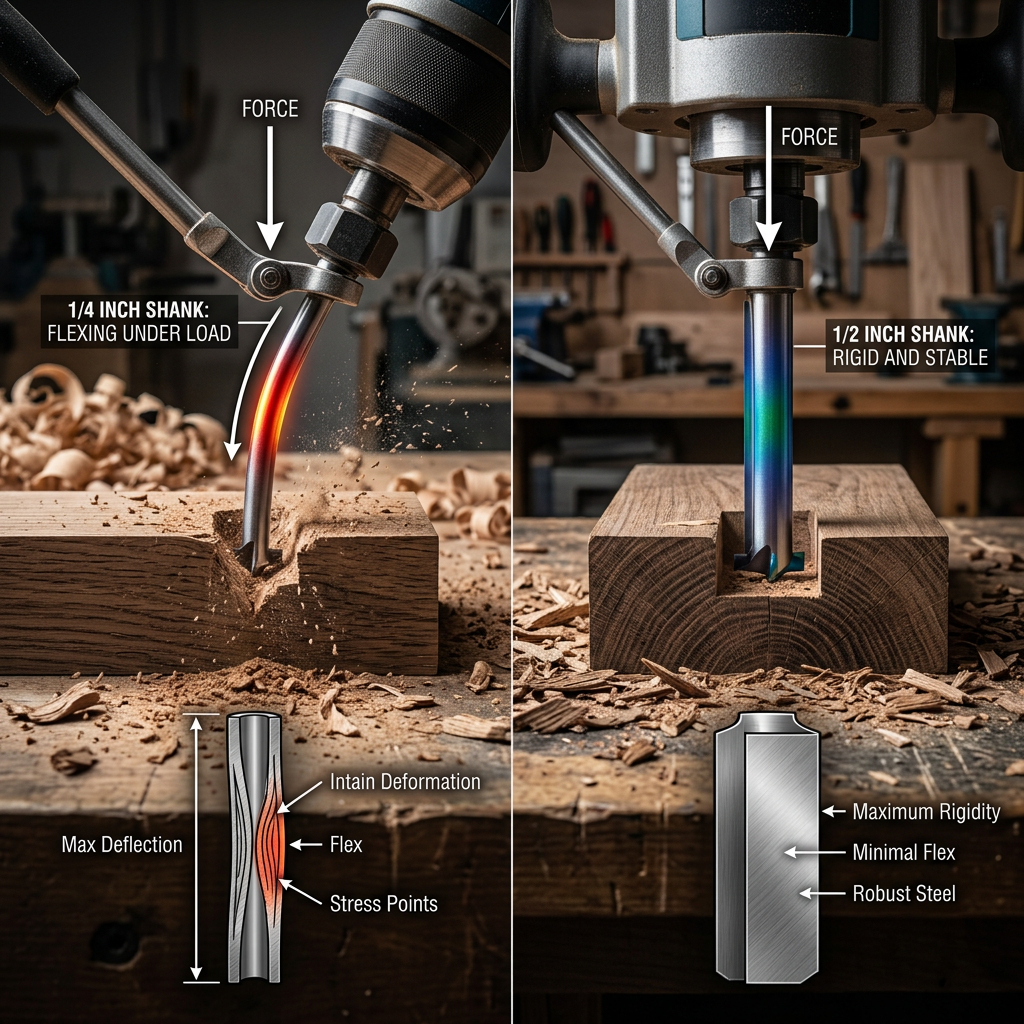
A 1/2" shank has 4x the cross-sectional area of a 1/4" shank. That's not double — it's four times. This means:
- Far less deflection under cutting load
- Tighter tolerances during profile cuts
- Less flex when routing hardwoods or taking heavy cuts
A 1/4" shank can flex under load, especially during climb cuts or when routing dense hardwoods. This flex shows up as chatter marks, wavy cuts, and inconsistent profiles.
Vibration
Vibration is the enemy of clean cuts. The smaller the shank, the more it vibrates at speed.
| Shank Size | Vibration Level | Cut Quality |
|---|---|---|
| 1/4" | Higher | Good (light cuts) |
| 1/2" | Lower | Better (all cuts) |
This vibration difference is most noticeable when:
- Routing hardwoods (maple, oak, walnut)
- Using large-diameter bits (over 1" diameter)
- Making deep cuts (over 1/4" depth per pass)
- Working at high RPM (over 20,000)
Collet Grip
A 1/2" shank has more surface area in contact with the collet. This means:
- Stronger grip — less chance of the bit slipping under load
- More concentric rotation — the bit spins truer, reducing runout
- Safer operation — bit ejection is less likely
Collet condition matters too. A worn or dirty collet can cause a 1/2" bit to slip just as easily as a 1/4" bit. Clean your collets regularly and replace them when worn.
Heat Dissipation
More steel = more mass = better heat dissipation. A 1/2" shank absorbs and disperses heat more effectively than a 1/4" shank, which helps:
- Keep the bit cooler during extended cuts
- Reduce heat-related carbide dulling
- Prevent burning on the workpiece
When to Use 1/4" Shank Bits
Despite the advantages of 1/2" shanks, 1/4" shank bits have legitimate uses:
Trim Routers
Most trim routers (compact, one-hand routers) only accept 1/4" shanks. If your router is a trim model — Bosch Colt, DeWalt DWP611, Makita RT0701C, or similar — you're limited to 1/4" bits.
Cordless Routers
Battery-powered routers almost universally use 1/4" collets. The smaller motor and battery design can't support the torque demands of 1/2" bits in heavy cuts.
Light-Duty Work
For very light trimming, edge profiling on softwoods, or quick touch-up work, 1/4" bits are perfectly adequate. If you're only removing a small amount of material, the rigidity advantage of 1/2" is negligible.
Specialty Profiles
Some specialty bit profiles are only available in 1/4" shank — certain small-diameter engraving bits, narrow spiral bits, and some decorative profiles.
When to Use 1/2" Shank Bits
Use 1/2" shank for:
- All table-mounted routing — the router table provides the stability, but the bit still needs to be rigid
- Hardwoods — oak, maple, walnut, cherry, and exotics all benefit from the extra rigidity
- Large-diameter bits — roundover bits over 3/8" radius, surfacing bits, large chamfer bits
- Deep cuts — anything over 1/4" depth per pass
- Production work — extended cutting sessions demand better heat dissipation
- CNC routing — 1/2" shanks are standard for CNC collets
Can You Use a 1/4" Bit in a 1/2" Collet?
Yes — with a collet reducer (also called a reducer sleeve). The sleeve adapts the 1/2" collet to grip a 1/4" shank.
However:
- The reducer adds another potential point of failure
- Runout can increase slightly
- You still get the vibration and stability issues of the 1/4" shank
Use a reducer when you need a specific bit that only comes in 1/4" — not as a permanent solution.
How to Check Your Router's Collet Size
- Check the manual — it will list accepted shank sizes
- Look at the collet — it's usually stamped with the size (1/4" or 1/2")
- Check the collet nut — some routers use a two-stage nut system that accepts both sizes
- Most full-size routers (2+ HP) accept both 1/4" and 1/2" via separate collets or a combo collet
If you're buying your first router, get one with a 1/2" collet. You can always add a 1/4" reducer, but you can't make a 1/4" collet accept a 1/2" shank.
The Cost Factor
1/2" shank bits cost slightly more than their 1/4" equivalents — typically 10–20% more for the same profile and brand.
This price difference is negligible when you consider:
- Cleaner cuts = less sanding = time saved
- Longer bit life = fewer replacements
- Less vibration = less wear on your router
Buy 1/2" shank. The few dollars extra is the best investment you'll make in cut quality.
Frequently Asked Questions
Q: Can I use 1/4" shank bits for hardwoods?
A: You can, but expect more vibration and potentially rougher cuts. For hardwoods over 1/2" thick, 1/2" shank is strongly recommended. See our router bit mistakes article for more on this.
Q: Do all routers accept both shank sizes?
A: No. Trim routers and most cordless routers only accept 1/4". Full-size routers (2+ HP) usually accept both. Check your router's specs.
Q: Are 1/2" shank bits harder to find?
A: No. 1/2" shank is the professional standard. Every major brand — CMT, Freud, Amana — offers their full range in 1/2" shank. 1/4" options are more limited.
Q: How do I choose a router if I want 1/2" shank capability?
A: Look for a router with at least 2 HP and a 1/2" collet included. Popular options include the Bosch 1617, DeWalt DW618, Makita RF1101, and Triton TRA001. All accept 1/2" shank and many come with a 1/4" adapter.
Q: What causes bit slippage in the collet?
A: Worn collet, dirty collet, or not tightening the collet nut enough. Clean your collet with compressed air, never overtighten (it can damage the collet), and replace the collet if you notice runout or slippage. Proper maintenance prevents most collet issues.