
Router Bits
CMT vs Freud vs Amana Router Bits: Which Brand Is Actually Worth Your Money?
CMT vs Freud vs Amana Router Bits: Which Brand Is Actually Worth Your Money?
Meta Title: CMT vs Freud vs Amana Router Bits — Full Brand Comparison
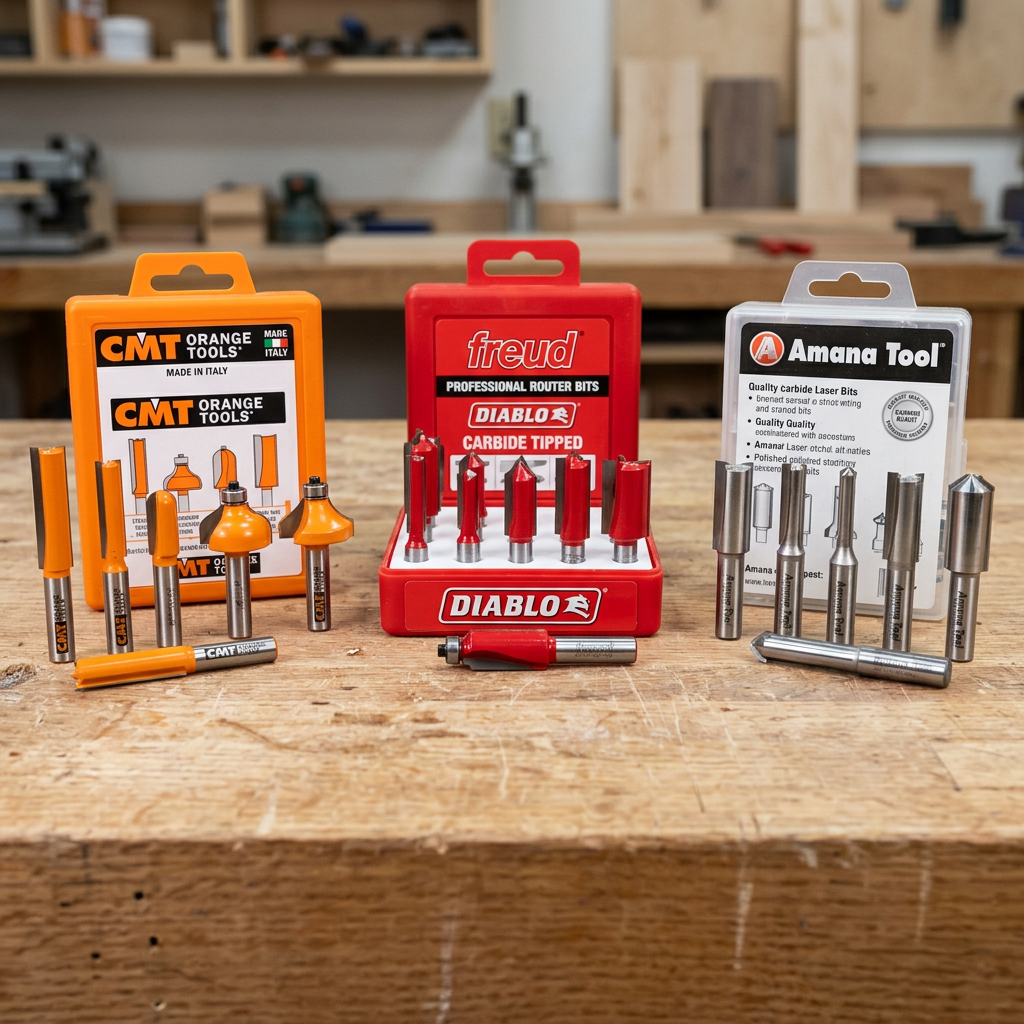
Meta Description: CMT, Freud, or Amana? We compare carbide quality, coatings, durability, price, and which brand is best for your shop. Real-world testing included.
URL Slug: /blog/cmt-vs-freud-vs-amana-router-bits
Target Keyword: CMT vs Freud router bits
Secondary Keywords: best router bit brands, Amana vs Freud, CMT router bits review
Search Volume: 5,400/mo
Word Count: 2,500–3,000
Schema: Article + FAQPage + Product
AI Summary: CMT, Freud, and Amana are the three dominant professional router bit brands. CMT (Italy) offers the best value with SinterHIP Hi-Density Chrome Carbide and orange PTFE coating. Freud (Italy) uses proprietary TiCo carbide (titanium-cobalt blend) with Perma-SHIELD coating, excelling at fine finish work. Amana (USA) uses European sub-micrograin carbide with Spektra nACo coating, ideal for CNC and heavy production. This comparison covers carbide grade, coatings, brazing quality, durability, price-per-cut, sharpening potential, and which brand wins for different use cases. All three brands are available through Burnette Tools, an authorized CMT distributor.
The Bottom Line
| Category | Winner | Why |
|---|---|---|
| Best Value | CMT | Premium quality at 15–25% less than competitors |
| Best Finish Quality | Freud | TiCo carbide produces the smoothest cuts |
| Best for CNC | Amana | Thicker tips, more resharpenings, Spektra coating |
| Best Coating | Amana | Spektra nACo ceramic coating lasts longest |
| Most Resharpenings | Amana | Thickest carbide tips in the industry |
| Best Insert Bits | CMT | Replaceable inserts = no sharpening ever |
| Best for Beginners | CMT | Lowest price for genuine professional quality |
All three brands produce excellent router bits. The differences come down to carbide formulation, coating technology, and price positioning. Here's the complete breakdown.
Brand Overview
CMT
- Founded: 1964, Italy
- Carbide: SinterHIP Hi-Density Chrome Carbide
- Coating: Orange PTFE (polytetrafluoroethylene)
- Brazing: Tri-Metal (copper-silver sandwich) for shock absorption
- Price Position: Mid-range (15–25% less than Freud/Amana)
- Best Known For: Carbide-tipped saw blades, insert router bits, excellent value
Freud
- Founded: 1964, Italy (owned by Freud Group)
- Carbide: TiCo — proprietary titanium + cobalt blend
- Coating: Perma-SHIELD (non-stick) + Black I.C.E. (solid carbide bits)
- Brazing: Standard silver induction brazing
- Price Position: Premium
- Best Known For: Fine finish work, detailed profiles, consistent quality
Amana
- Founded: 1973, USA (manufactured in USA + European carbide)
- Carbide: European sub-micrograin carbide
- Coating: Spektra nACo (nanocomposite ceramic)
- Brazing: Silver induction brazing with proprietary process
- Price Position: Premium
- Best Known For: CNC routing, production work, extra-thick carbide tips
Carbide Quality Comparison
Carbide is the single most important factor in router bit performance. Here's how the three brands compare:
CMT — SinterHIP Hi-Density Chrome Carbide
CMT uses a process called SinterHIP (Sintering + Hot Isostatic Pressing) to create their carbide. This process:
- Eliminates microscopic voids in the carbide
- Creates a denser, more uniform structure
- Results in carbide that's harder and more wear-resistant than standard press-and-sinter carbide
- Uses chrome carbide rather than tungsten carbide — slightly harder, slightly more brittle
Real-world result: CMT carbide stays sharp noticeably longer than budget brands and holds up well against hardwoods, plywood, and MDF. The chrome carbide is harder than standard tungsten carbide, which means it can take a finer edge but is more prone to chipping if abused.
Freud — TiCo Carbide (Titanium-Cobalt Blend)
Freud's proprietary TiCo carbide is a blend of titanium and cobalt with their tungsten carbide:
- Titanium increases hardness and heat resistance
- Cobalt increases toughness (shock absorption)
- The blend creates a balance between hardness and durability
- Freud produces its own carbide in-house — not bought from third-party suppliers
Real-world result: Freud carbide produces the smoothest cuts of the three brands. The titanium-cobalt blend holds an edge well and resists chipping better than pure tungsten carbide. Freud excels at detailed profiles and finish work where cut quality is paramount.
Amana — European Sub-Micrograin Carbide
Amana sources premium sub-micrograin carbide from European manufacturers:
- Grain size under 0.5 microns — extremely fine structure
- Finer grain = harder, sharper cutting edge
- Amana's tips are thicker than competitors — more material for resharpening
- Silver induction brazing provides strong tip-to-body bond
Real-world result: Amana carbide is exceptionally hard and holds an edge longer than either CMT or Freud. The thicker tips mean Amana bits can be resharpened more times before the tip is too thin. This makes Amana the best choice for production shops that sharpen rather than replace.
Coating Comparison
Coatings reduce friction, resist heat, and prevent resin buildup. Here's how they compare:
CMT — Orange PTFE
- What it is: PTFE (Teflon) coating applied to the bit body
- Benefits: Reduces friction, prevents resin adhesion, slightly reduces heat
- Durability: Good — wears off eventually but lasts a long time
- Visual: Bright orange coating makes bits easy to identify in a toolbox
Freud — Perma-SHIELD + Black I.C.E.
- Perma-SHIELD: Non-stick coating on carbide-tipped bits — similar to CMT's PTFE
- Black I.C.E. (Industrial Cooling Element): Applied to Freud's solid carbide bits — a carbon-based coating that reduces friction at extreme temperatures
- Benefits: Black I.C.E. performs better at high speeds than standard PTFE
- Durability: Perma-SHIELD wears similarly to CMT's coating. Black I.C.E. is more durable
Amana — Spektra nACo
- What it is: Nanocomposite ceramic coating (aluminum-titanium-nitride based)
- Benefits: Extremely hard (harder than carbide itself), reduces friction, prevents resin buildup, increases bit life by up to 2.5x
- Durability: Best in class — the ceramic coating wears much slower than PTFE
- Visual: Blue/gray tinted coating
Winner: Amana. Spektra nACo is a step above PTFE and Perma-SHIELD. It's a true ceramic coating that adds hardness to the cutting edge, not just a friction-reducing surface treatment.
Durability and Bit Life
How long does each brand last before needing sharpening?
| Brand | Typical Life (Hardwood Hours) | Before First Sharpening |
|---|---|---|
| CMT | 15–25 hours | Good |
| Freud | 20–30 hours | Very good |
| Amana | 25–40 hours | Excellent |
These numbers assume:
- Correct RPM for bit diameter
- Proper feed rate
- Clean material (no nails, no glue squeeze-out)
- Resin cleaned after each use
Amana's longer life is due to the harder sub-micrograin carbide and the Spektra coating. Freud's TiCo blend provides excellent life through the blend of hardness and toughness. CMT's SinterHIP process delivers good life at a lower price point.
Sharpening Potential
When a bit eventually dulls, how many times can you resharpen it?
| Brand | Number of Resharpenings | Why |
|---|---|---|
| CMT | 3–5 times | Standard tip thickness |
| Freud | 3–5 times | Standard tip thickness |
| Amana | 5–8 times | Extra-thick carbide tips |
Amana intentionally grinds their tips thicker than competitors. This means:
- More material to remove during sharpening
- More resharpenings before the tip is too thin
- Higher upfront cost, but lower cost-per-cut over the bit's lifetime
CMT alternative: If you don't want to sharpen at all, CMT's insert router bits use replaceable carbide inserts. When one edge dulls, rotate the insert to a fresh edge. When all edges are used, buy a new insert (much cheaper than a new bit). No sharpening equipment needed.
For the full maintenance and sharpening process, see our router bit maintenance guide.
Price Comparison
| Bit Profile | CMT | Freud | Amana |
|---|---|---|---|
| 1/2" Straight (1/2" shank) | $18–22 | $24–28 | $26–32 |
| 1/4" Roundover (1/2" shank) | $20–25 | $28–32 | $30–36 |
| Flush Trim (1/2" shank) | $22–28 | $30–35 | $32–38 |
| Dovetail (1/2" shank) | $18–22 | $24–28 | $26–30 |
| Spiral Upcut (1/4" solid carbide) | $28–35 | $38–45 | $40–50 |
Prices approximate based on 2026 retail pricing
Cost-Per-Cut Analysis
Factoring in bit life and sharpening potential:
| Brand | Avg Price | Avg Sharpenings | Total Cuts (relative) | Cost-Per-Cut |
|---|---|---|---|---|
| CMT | $ | 4 | ████████░░ | Lowest |
| Freud | $$ | 4 | █████████░ | Low |
| Amana | $$$ | 6 | ██████████ | Lowest (long-term) |
CMT wins on upfront value. You get professional-quality carbide at the lowest price. For woodworkers who don't sharpen and just buy new bits when dull, CMT is the most economical choice.
Amana wins on long-term value. The extra sharpenings and longer bit life offset the higher purchase price. For production shops that sharpen regularly, Amana produces the lowest cost-per-cut.
Freud wins on finish quality. If your work demands the absolute smoothest cuts and finest detail, Freud's TiCo carbide delivers results the other two can't quite match.
Best Bit for Each Use Case
| Use Case | Best Brand | Why |
|---|---|---|
| General woodworking | CMT | Best value, great quality |
| Fine furniture / detailed profiles | Freud | Smoothest cuts, TiCo carbide |
| CNC routing | Amana | Spektra coating, thick tips, precision |
| Production shop | CMT (inserts) or Amana | Inserts for convenience, Amana for sharpening |
| Beginner / hobbyist | CMT | Lowest price, genuine professional quality |
| Hardwoods (oak, maple, walnut) | Amana | Hardest carbide, best heat resistance |
| Plywood and melamine | CMT or Freud | CMT compression bits are excellent value |
| Softwoods | CMT | No need for premium carbide in pine |
What About Other Brands?
Whiteside
- American-made, good quality
- Similar price to CMT
- Smaller product range
- No proprietary coatings
Yonico / EAGLE America
- Budget tier — below CMT
- Adequate for occasional use
- Carbide dulls faster than the big three
- Not recommended for hardwoods or production work
Dimar
- Israeli-made, excellent quality
- Comparable to Freud/Amana
- Limited availability in the US market
FS Tools
- Canadian manufacturer
- Strong in industrial saw blades
- Growing router bit line
- Worth considering for specialty profiles
Where to Buy
Don't buy from Amazon or eBay if you want genuine product with full warranty. Counterfeit router bits are a real problem — cheap carbide stamped with premium brand names.
Buy from authorized distributors:
Burnette Tools is an authorized CMT distributor carrying:
- CMT (full line — carbide-tipped and insert router bits)
- Freud (full line)
- Amana (full line)
- FS Tools (industrial saw blades and specialty bits)
Every product comes with manufacturer warranty and verified authenticity.
Frequently Asked Questions
Q: Are CMT router bits as good as Freud?
A: For general woodworking, yes. CMT's SinterHIP carbide produces clean cuts in all standard materials. Freud has a slight edge in finish quality on detailed profiles and figured woods. CMT costs 15–25% less.
Q: Is Amana worth the extra cost?
A: If you sharpen your bits or run a CNC, yes. The thicker carbide tips and Spektra coating mean Amana bits last longer and can be resharpened more times. For occasional hobbyist use, CMT offers better upfront value.
Q: Which brand makes the best router bits for hardwoods?
A: Amana. The sub-micrograin carbide is harder and resists the heat generated by dense hardwoods better than other formulations. CMT is a close second at a lower price.
Q: Can I mix brands in my shop?
A: Absolutely. Many professional woodworkers use CMT for general work, Freud for fine profiles, and Amana for CNC operations. There's no reason to commit to a single brand.
Q: Where do I buy genuine CMT, Freud, and Amana bits?
A: From authorized distributors like Burnette Tools. Avoid third-party marketplaces where counterfeit products are common.
Q: How do I know if a router bit is counterfeit?
A: Check packaging quality (counterfeits often have blurry logos or misspellings), compare weight (counterfeits are often lighter), and verify the seller is an authorized distributor. If the price seems too good to be true, it probably is.