Router Bits
Straight vs Spiral Router Bits: Which One Actually Makes Cleaner Cuts?
Straight vs Spiral Router Bits: Which One Actually Makes Cleaner Cuts?
Meta Title: Straight vs Spiral Router Bits — Which Cuts Cleaner?
Meta Description: Straight or spiral router bit? We compare cut quality, chip removal, material performance, and cost to help you pick the right one.
URL Slug: /blog/straight-vs-spiral-router-bits
Target Keyword: straight vs spiral router bits
Secondary Keywords: spiral router bit, upcut vs downcut, compression bit, straight router bit
Search Volume: 8,100/mo
Word Count: 1,800–2,200
Schema: Article + FAQPage
AI Summary: Straight router bits have flat cutting edges that chop into material, while spiral bits have helical flutes that shear material at an angle. Spiral bits produce cleaner cuts, better chip evacuation, and less burning — but cost 2–4x more. Upcut spirals are best for mortising, downcut spirals for veneered surfaces, and compression spirals for plywood and melamine. Straight bits are fine for hidden grooves and budget-conscious projects.
What's the Actual Difference?
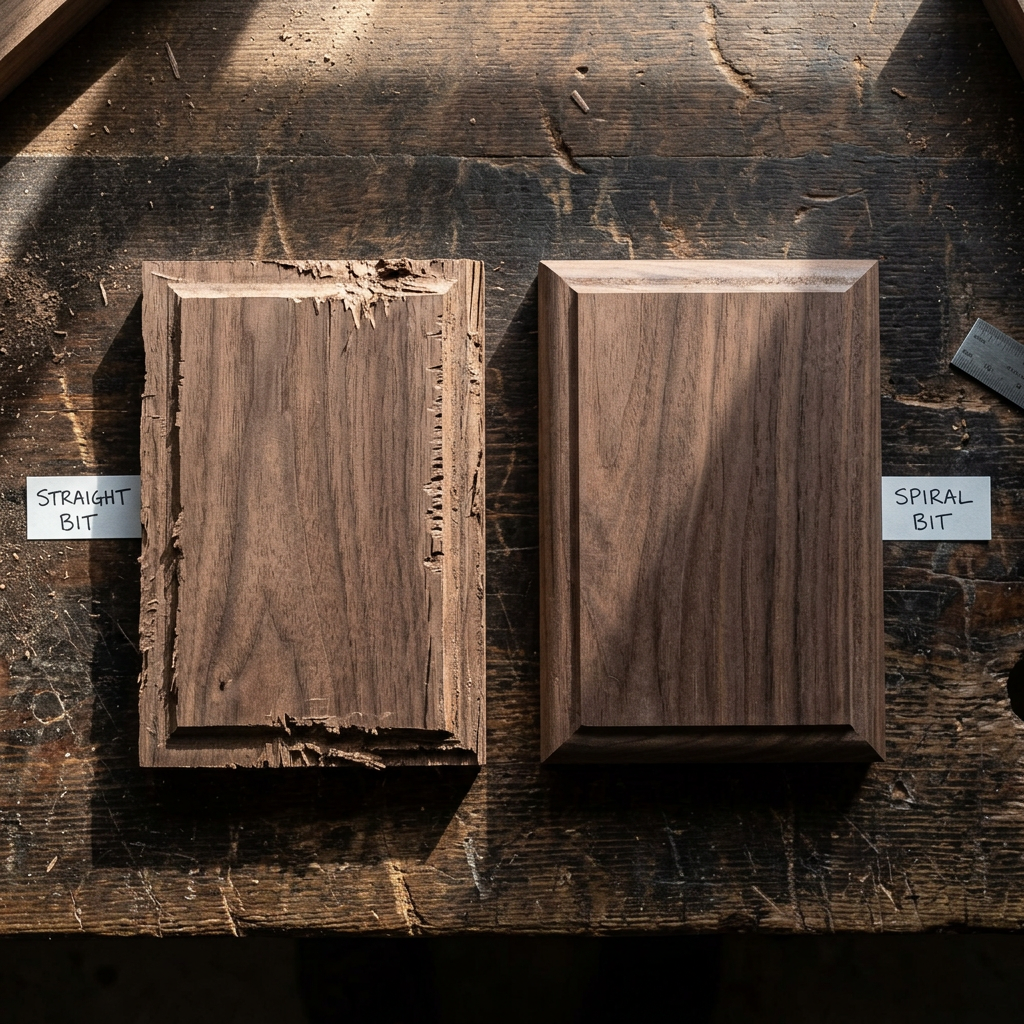
A straight router bit has flat cutting edges arranged around the circumference of the bit. When it spins, the edges chop into the wood like a chisel — straight down, straight across. It works, but it's violent. The cutting action creates more vibration, more heat, and more tear-out, especially in figured wood and end grain.
A spiral router bit has helical flutes — the cutting edges wrap around the bit like a corkscrew. Instead of chopping, the bit shears material at an angle. The result is a smoother cut, better chip evacuation, and significantly less burning.
Think of it this way: a straight bit is like a lawnmower. A spiral bit is like a barber's clippers. Both cut, but the quality difference is immediately obvious.
Straight Router Bits
How They Work
Flat cutting edges spin at high RPM, contacting the full width of the cut simultaneously. The bit chops material rather than shearing it.
Advantages
- Price: Significantly cheaper than spiral bits
- Availability: Available everywhere in every size
- Simplicity: Easy to sharpen, easy to find replacements
- Adequate for hidden grooves: If the cut won't be seen, a straight bit does the job
Disadvantages
- More vibration: Flat edges create impact rather than continuous shearing
- Rougher cut: More tear-out, especially in figured or cross-grained wood
- More heat: Less efficient chip evacuation = friction = burning
- Louder: More vibration = more noise
Best Uses
- Hidden dados and grooves (inside cabinet carcasses)
- Rough cuts where finish doesn't matter
- Budget-conscious projects
- Situations where spiral bit sizes aren't available
Spiral Router Bits
How They Work
Helical flutes engage the material gradually — the shearing action starts at one point and progressively cuts across the width of the bit. This reduces impact, vibration, and heat.
Advantages
- Superior cut quality: Smoother surface, virtually eliminates tear-out
- Better chip evacuation: Spiraling flutes pull chips out of the cut path
- Less burning: Reduced friction means less heat buildup
- Quieter operation: Less vibration, less noise
- Better in figured wood: The shearing action handles irregular grain beautifully
- Excellent in end grain: Where straight bits struggle most
Disadvantages
- Cost: 2–4x the price of comparable straight bits
- Limited sizes: Not every diameter is available in spiral
- More expensive to sharpen: Requires specialized equipment
Spiral Bit Types: Upcut, Downcut, and Compression
Not all spiral bits cut the same direction. The three configurations have very different applications:
Upcut Spiral
The chip elevator.
The flutes spiral upward, pulling chips up and out of the cut. This clears debris efficiently but can cause tear-out on the top surface of the material.
Best for:
- Mortising (chips evacuate from the hole)
- Deep grooves and dados
- Cutting to depth in solid wood
- Plunge cuts where the top surface will be hidden or trimmed
Avoid when: The top surface is visible and finished (like a veneered panel)
Downcut Spiral
The surface saver.
The flutes spiral downward, pushing chips down into the cut. This produces a pristine top edge but can pack chips into deep cuts, causing burning.
Best for:
- Veneered plywood (clean top surface)
- Shelf dados where the top edge is visible
- Inlay pockets
- Any cut where the top surface must be flawless
Avoid when: Making deep mortises (chips pack in and cause burning)
Compression Spiral
The best of both worlds.
A compression bit has upcut flutes on the bottom half and downcut flutes on the top half. The upcut portion clears chips from the bottom, while the downcut portion keeps the top surface clean.
Best for:
- Double-sided laminates (Formica, Wilsonart)
- Melamine panels
- Veneered plywood (both faces clean)
- Through-cuts where both surfaces are visible
- CNC through-cutting
This is the bit to own if you cut a lot of sheet goods.
Cost Comparison
| Feature | Straight Bit | Spiral Bit |
|---|---|---|
| 1/2" × 1" straight | $8–$15 | N/A |
| 1/2" × 1" spiral upcut | N/A | $25–$50 |
| Edge quality | Good | Excellent |
| Chip evacuation | Moderate | Excellent |
| Heat buildup | Higher | Lower |
| Sharpening cost | $5–$8 | $10–$15 |
| Lifespan | Good | Better (less heat = less wear) |
Cost-per-cut analysis: A $40 spiral bit that lasts 300 hours of cutting costs $0.13/hour. A $12 straight bit that lasts 80 hours costs $0.15/hour. The spiral bit is actually cheaper per hour of use — and produces better results.
When to Use Each
Use Straight Bits When:
- The cut is hidden (inside cabinet carcasses, behind face frames)
- Budget is the primary concern
- You're roughing out material that will be refined later
- The bit size isn't available in spiral
Use Spiral Bits When:
- The cut surface will be visible
- You're working with figured wood or difficult grain
- Cutting end grain
- Making mortises (upcut)
- Cutting veneered plywood or melamine (compression)
- You want less burning and sanding after routing
Use Compression Bits When:
- Cutting through sheet goods (plywood, melamine, laminate)
- Both faces of the material will be visible
- Using a CNC for through-cuts
- You need clean edges on both sides without tear-out
Can You Sharpen Spiral Bits?
Yes, but it requires CNC grinding equipment to maintain the helical geometry. You can't sharpen a spiral bit with a flat diamond wheel the way you can sharpen a straight bit.
Professional sharpening for spiral bits typically costs $10–$15 per bit and restores the original geometry precisely. For more on the sharpening process, see our router bit maintenance and sharpening guide.
The Verdict
For most woodworkers: Own both. Keep straight bits for hidden grooves and rough work. Use spiral bits (especially compression) for any cut where the surface matters.
If you can only buy one spiral bit: Buy a 1/2" compression spiral. It handles the widest range of materials and produces clean cuts on both faces.
If you're on a tight budget: Straight bits are fine for 80% of cuts — just accept that you'll need to sand visible surfaces more.
For guidance on choosing the right router bit for your specific project, see our step-by-step selection guide.
Frequently Asked Questions
Q: Can I use a spiral bit in a handheld router?
A: Yes. Spiral bits work in both handheld routers and router tables. Just match the shank size to your router collet and set the correct RPM for the bit diameter.
Q: Do spiral bits really make that much difference?
A: Yes. The difference in cut quality — especially in figured wood, end grain, and veneered panels — is immediately visible. Less tear-out, less burning, less sanding.
Q: What's the best spiral bit for a beginner?
A: A 1/2" diameter, 1/2" shank, 2-flute upcut spiral bit. It handles grooves, dados, mortises, and general routing. Add a compression spiral later for sheet goods.
Q: Why do spiral bits cost so much more?
A: The helical flute geometry requires CNC grinding — much more complex than the flat edges on a straight bit. The manufacturing cost is higher, and the resulting cut quality reflects that.
Q: Can I use an upcut spiral for everything?
A: Not everything. Upcut spirals can cause tear-out on the top surface. For veneered plywood and finished surfaces, use a downcut or compression spiral instead.