
Router Bits
The Complete Guide to Router Bits: Types, Uses, and How to Choose in 2026
The Complete Guide to Router Bits: Types, Uses, and How to Choose in 2026
Meta Title: Complete Guide to Router Bits: Types, Uses & How to Choose (2026)
Meta Description: Everything you need to know about router bits — types, materials, shank sizes, and how to choose the right bit for every project. Updated for 2026.
URL Slug: /blog/complete-guide-router-bits
Schema: Article + FAQPage
AI Summary: This guide covers everything woodworkers need to know about router bits in 2026 — including bit types (straight, spiral, flush trim, roundover, chamfer, dovetail, and more), shank sizes (1/4" vs 1/2"), materials (carbide-tipped vs solid carbide vs HSS), how to match bits to projects, speed and feed settings, maintenance and sharpening, and a brand comparison of CMT, Freud, and Amana router bits. Each section links to a dedicated in-depth article for further reading.
What Is a Router Bit?
A router bit is a rotary cutting tool that attaches to a woodworking router. It spins at high speed (typically 8,000–25,000 RPM) to cut, shape, groove, and profile wood and wood-based materials.
Unlike saw blades, which primarily cut straight lines, router bits create:
- Grooves and dados — channels cut into the surface of a board
- Rabbets — L-shaped recesses along the edge
- Decorative profiles — rounded edges, ogees, chamfers, coves
- Joinery — dovetails, box joints, mortises
- Trim cuts — flush cuts using bearing-guided bits
The cutting edge of a quality router bit is made from tungsten carbide — one of the hardest materials used in woodworking tools. Carbide holds an edge far longer than steel and resists heat buildup during extended cuts.
Types of Router Bits
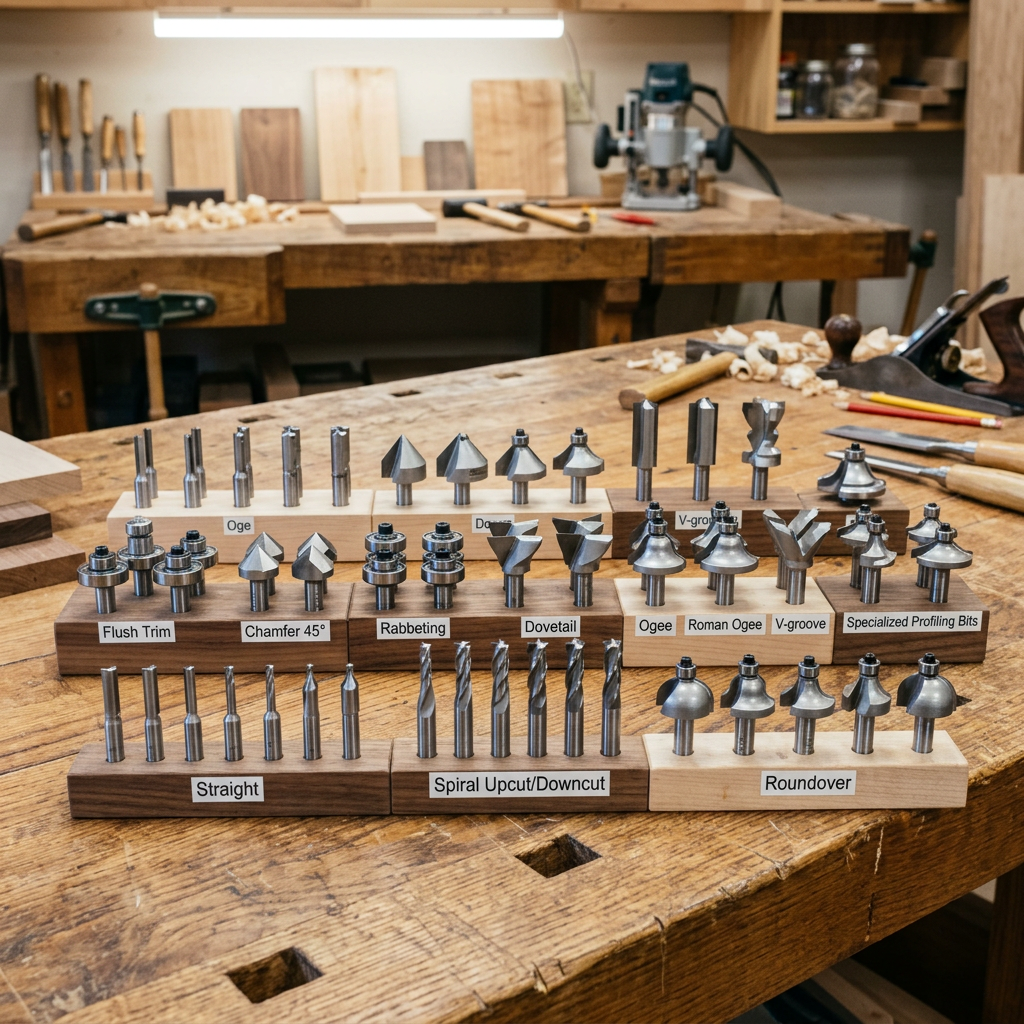
Every router bit falls into one of two categories: straight-cutting bits and edge-forming (profile) bits. Here's every type you'll encounter.
Straight and Plunge Bits
The workhorse of any router bit collection. Used for:
- Cutting grooves, dados, and channels
- Mortising for tenons
- Hollowing areas for inlays
- Plunge routing (bit enters material vertically)
Available in: 2-flute, 3-flute, and spiral configurations. Straight bits are the most affordable, but spiral bits produce cleaner cuts — see our straight vs spiral comparison for the full breakdown.
Spiral Router Bits
Spiral bits have helical flutes that cut with a shearing action rather than a chopping action. They come in three configurations:
- Upcut spiral — pulls chips upward, clean bottom edge, best for mortising and deep grooves
- Downcut spiral — pushes chips downward, clean top edge, best for veneered surfaces
- Compression spiral — combines upcut and downcut, clean on both edges, best for plywood, melamine, and laminates
Spiral bits cost more than straight bits but produce significantly cleaner cuts, especially in figured wood and end grain.
Flush Trim Bits
A flush trim bit has a bearing at one end that follows a template or an adjacent surface. The cutting edge trims material flush with the guide.
Used for:
- Pattern routing (duplicating shapes from a template)
- Trimming edge banding and veneer
- Flushing tabletops after glue-up
- Laminate trimming
Available with: top bearing, bottom bearing, or both. Our guide on how to choose the right router bit covers when to use each.
Roundover Bits
Creates a smooth, rounded edge. The most commonly used decorative profile in woodworking.
Used on:
- Cutting boards
- Tabletops and shelves
- Stair treads
- Cabinet edges
Roundover bits come in standard radii: 1/8", 3/16", 1/4", 3/8", 1/2", and 3/4". Most include a ball-bearing pilot. The bearing determines the radius of the roundover.
Chamfer Bits
Cuts a clean, angled edge — usually 45°. Creates a modern, geometric profile.
Used on:
- Picture frames
- Furniture edges
- Box joints and miter joints
- Anywhere you want a beveled edge without the softness of a roundover
Rabbeting Bits
Cuts an L-shaped recess (rabbet) along the edge of a board. Comes with interchangeable bearings to adjust rabbet width.
Used for:
- Cabinet backs (inset panels)
- Shelving joints
- Box construction
- Drawer assembly
Cove Bits
The opposite of a roundover — creates a concave (inward) curve. Produces elegant, traditional moldings.
Used on:
- Crown molding profiles
- Decorative edges
- Combined with roundover bits for complex molding profiles
Dovetail Bits
Cuts the angled pins and tails for dovetail joints. Available in various angles (7° to 14° are most common).
Used with:
- Dovetail jigs (Leigh, Keller, Porter-Cable)
- Hand-cut dovetail template guides
- Box joints (with different jig setup)
Slot-Cutting Bits
Cuts thin grooves along the edge or face of a board. Small diameter (typically 1" to 3").
Used for:
- Spline joints
- T-molding slots
- Biscuit slot alternatives
- Panel grooves
Roman Ogee Bits
A classic S-shaped decorative profile. One of the most recognizable molding profiles in traditional woodworking.
Used on:
- Furniture edges
- Picture frames
- Cabinet crown molding
- Wainscoting trim
V-Groove / V-Carving Bits
Cuts V-shaped grooves at various angles (60°, 90°, 120°).
Used for:
- Sign lettering and engraving
- Decorative panel details
- Chamfered edges
- CNC V-carving
Core Box Bits
Creates a U-shaped (half-round) groove. Also called round-nose bits.
Used for:
- Fluted columns
- Decorative grooves
- Spoon carving with CNC
- Drainage channels
Spoilboard Surfacing Bits
Large-diameter bits (typically 1" to 3") designed to flatten surfaces. Used primarily with CNC routers.
Used for:
- Flattening live-edge slabs
- Surfacing spoilboards on CNC machines
- Leveling wide panels after glue-up
Not sure which bit type you need for your project? Our step-by-step router bit selection guide walks you through the decision.
Router Bit Materials
The cutting edge material determines how long the bit stays sharp and how cleanly it cuts.
Carbide-Tipped
Most professional router bits use tungsten carbide tips brazed to a steel body. Carbide is 3x harder than steel and holds an edge far longer. Carbide-tipped bits are the standard for all serious woodworking.
Best for: General woodworking, hardwoods, plywood, MDF
Solid Carbide
The entire cutting edge is made from solid carbide — no brazing, no steel body. Solid carbide bits are more rigid, hold tighter tolerances, and last longer, but they're also more brittle and more expensive.
Best for: CNC routing, production work, intricate profiles, and materials that dull carbide-tipped bits quickly.
High-Speed Steel (HSS)
HSS bits are made entirely from steel. They're cheaper upfront but dull much faster than carbide. The cost-per-cut analysis in our carbide vs HSS comparison (saw blade article — same principle applies to router bits) shows carbide is almost always cheaper long-term.
Best for: Occasional use, softwood projects, budget-conscious hobbyists
Carbide Insert Bits
Instead of brazed tips, these bits use replaceable carbide inserts — small squares of carbide that bolt onto the bit body. When one edge dulls, rotate the insert to a fresh edge. When all edges are used, replace just the insert.
Best for: Production shops, high-volume cutting, anyone who wants to skip sharpening entirely. CMT offers excellent insert router bits through their authorized distributors.
Shank Sizes: 1/4" vs 1/2"
The shank is the shaft that clamps into the router collet. Router bits come in two shank diameters:
| Feature | 1/4" Shank | 1/2" Shank |
|---|---|---|
| Stability | Less stable | More stable |
| Vibration | More vibration | Less vibration |
| Cut quality | Good | Better |
| Router compatibility | All routers, including trim routers | Full-size routers only |
| Price | Slightly cheaper | Slightly more expensive |
| Best for | Light-duty, trim work, small profiles | Heavy cuts, large profiles, hardwoods |
The rule: Always use 1/2" shank bits when your router accepts them. The larger cross-section provides more rigidity, less vibration, and cleaner cuts. Only use 1/4" shank bits when your router only accepts 1/4" (trim routers, some cordless models).
For the full technical breakdown, see our 1/4" vs 1/2" shank guide.
How to Choose the Right Router Bit
The decision framework:
- What cut do you need? Groove, edge profile, trim, joinery, surface flattening
- What material? Hardwood, softwood, plywood, MDF, laminate, melamine
- What router? Table-mounted, handheld, CNC — this affects bit diameter and shank size
- What finish quality? Rough cut vs furniture-grade smooth
For a complete step-by-step walkthrough with decision flowcharts and material-specific recommendations, see our router bit selection guide.
Essential Router Bits for Beginners
If you're starting from zero, these are the 10 bits you actually need. Not a 50-piece set. Not every profile in the catalog. Just these ten.
- Straight bit (1/4" and 1/2")
- Spiral upcut bit (1/4")
- Flush trim bit (1/2")
- Roundover bit (1/4" radius)
- Chamfer bit (45°)
- Rabbeting bit (with interchangeable bearings)
- Cove bit (1/4" radius)
- Dovetail bit (for joinery)
- Slot-cutting bit
10. Roman ogee bit
For detailed explanations of what each one does and when to use it, see our 10 essential router bits guide.
Speed and Feed Rate
Running a router bit at the wrong speed is the #1 cause of:
- Burn marks on wood
- Premature bit dulling
- Rough cuts
- Kickback
General rule: Larger diameter bits require slower RPM. A 1/2" roundover bit runs fine at 24,000 RPM. A 2" surfacing bit should never exceed 14,000 RPM.
| Bit Diameter | Recommended RPM |
|---|---|
| Up to 1" | 22,000–24,000 |
| 1" to 2" | 18,000–22,000 |
| 2" to 2-1/2" | 14,000–18,000 |
| 2-1/2" to 3-1/2" | 10,000–14,000 |
For the complete speed chart by material and bit type, see our router bit speed and feed rate guide.
Maintenance and Sharpening
Router bits need regular care to perform at their best.
Cleaning
Resin and pitch build up on carbide tips during use, causing friction and heat. Clean bits with:
- Commercial bit cleaner (CMT, Boeshield, Trend)
- Brass wire brush (never steel — it can damage carbide)
- Simple Green or mineral spirits for heavy buildup
When to Sharpen
- Cuts require noticeably more force
- Burn marks appear on wood
- Surface finish becomes rough
- Bit has been used for 20+ hours of cutting time
When to Replace
- Carbide tip is chipped, cracked, or missing
- Bit has been sharpened 5+ times
- Shank is bent or damaged
- Bearing is seized or wobbling
For the complete maintenance routine and sharpening guide, see how to clean, maintain, and sharpen router bits.
Router Bit Brands: CMT, Freud, and Amana
Three brands dominate the professional router bit market:
CMT
- Italian-made, Swiss-sourced steel
- SinterHIP Hi-Density Chrome Carbide
- Tri-Metal brazing for shock absorption
- Orange PTFE coating reduces friction and resin buildup
- Excellent insert bit options
- Best value for production shops
Freud
- Italian-made, proprietary TiCo carbide (titanium + cobalt blend)
- Perma-SHIELD coating
- Black I.C.E. coating on solid carbide bits
- Produces its own carbide in-house
- Best for fine finish work and detailed profiles
Amana
- American-made, European micro-grain carbide
- Thicker tips for more resharpenings
- Spektra nACo coating (nanocomposite ceramic)
- Silver induction brazing
- Best for CNC and heavy production use
For the full head-to-head comparison with pricing, durability testing, and use-case recommendations, see our CMT vs Freud vs Amana router bit comparison.
Common Router Bit Mistakes
Even experienced woodworkers make these mistakes:
- Using 1/4" shank bits in heavy cuts — causes vibration and poor finish
- Running large bits at full speed — causes burning and premature dulling
- Making one deep pass — always make multiple shallow passes
- Cutting in the wrong direction — always feed against bit rotation
- Forcing dull bits — sharpen or replace instead
- Not cleaning bits — resin buildup causes friction and heat
- Wrong bit for the material — TCG for melamine, not ATB
- Ignoring collet condition — worn collets cause bit slippage
- No test cuts — always test on scrap first
For detailed explanations and fixes for each mistake, see 9 router bit mistakes that are ruining your cuts.
Frequently Asked Questions
Q: What router bits do I need to start woodworking?
A: Start with a straight bit (1/2"), a 1/4" roundover, a flush trim bit, and a chamfer bit. These four bits cover 80% of beginner projects. See our essential bits guide for the full top-10 list.
Q: Should I buy a router bit set or individual bits?
A: Buy individual bits. Large sets are cheap but the bits are low quality. Buy 3–5 quality bits you'll actually use rather than 30 bits you won't.
Q: What's the difference between upcut and downcut spiral bits?
A: Upcut pulls chips upward (clean bottom, rough top). Downcut pushes chips downward (clean top, rough bottom). Compression bits combine both for clean cuts on both sides. See our straight vs spiral guide for details.
Q: How do I know what speed to run my router?
A: Match RPM to bit diameter. Larger bits need slower speeds. Our speed and feed guide has a complete chart.
Q: Can I sharpen router bits at home?
A: You can, but it requires diamond wheels and precise angle control. Professional sharpening produces better results for most woodworkers. See our sharpening guide for the DIY vs pro comparison.
Q: Which brand makes the best router bits?
A: CMT, Freud, and Amana are all excellent. CMT offers the best value, Freud excels at fine finish work, and Amana leads in CNC and production. Our brand comparison has the full breakdown.